

Logistics and Leviathan
Logistics and Leviathan both conjure magical visuals and reveal haunting realities. These are two of the most important documentaries on water.
Logistics is famously the longest film ever made. Created in 2012 by Erika Magnusson and Daniel Andersson, it follows the real-time route of a pedometer in reverse chronology, from Stockholm, Sweden and travelling to Shenzhen, China. This behemoth of a film clocks in at 51,420 minutes, or roughly 35 days and 17 hours, breaking down the slow, methodical machinery of global capitalism. Critic Ashley Darrow encapsulates the key themes of the project well, arguing that Logistics depicts ‘alienation, isolation and just how much capitalist social relations have distorted our ability to understand time and space (Darrow, 2022). For the vast majority of the runtime, the camera captures a single angle of a cargo ship, endlessly watching the immense vista of the horizon and the complete emptiness of the world’s oceans.
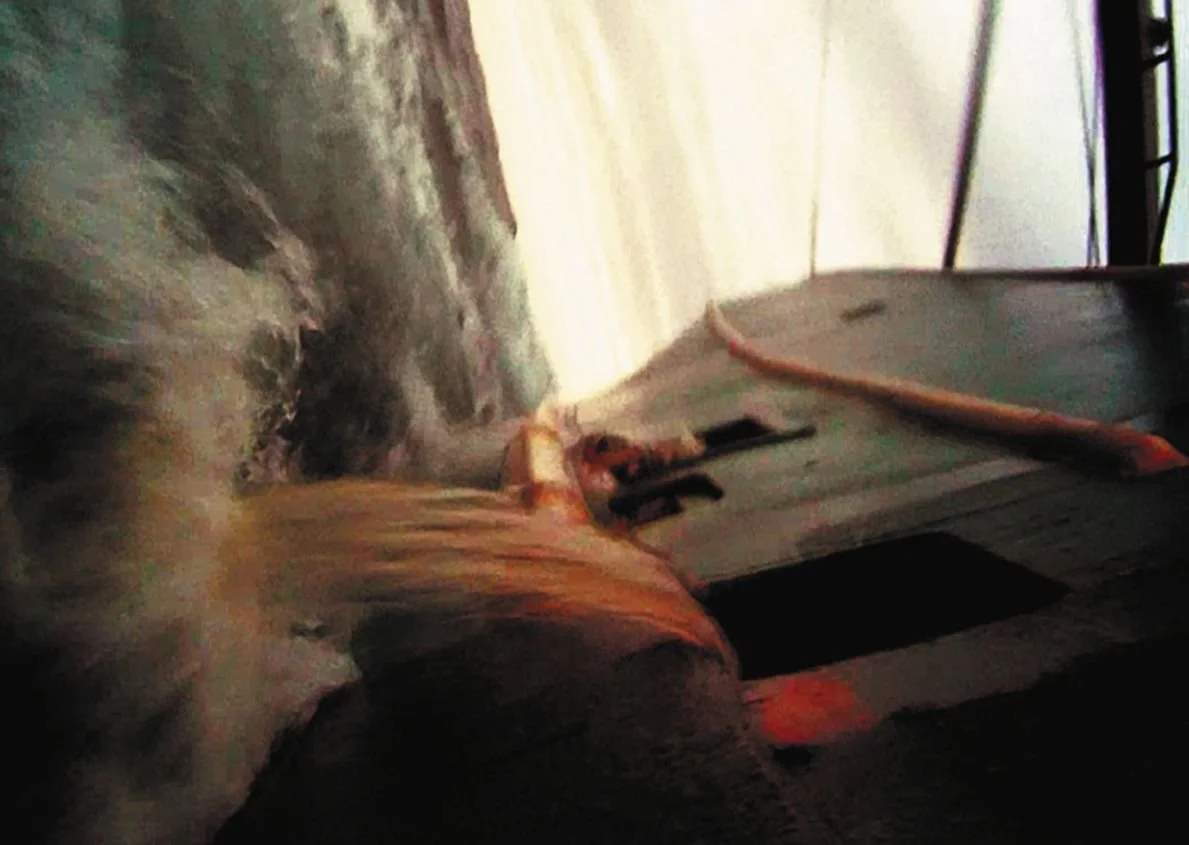
By contrast , 2012’s Leviathan is frantic and claustrophobic - a visceral plunge into the North American fishing industry.Among the first films to harness GoPro cameras so extensively, it stands in near-total opposition to Logistics. Nick Pinkerton describes the camera choice as being ‘used to penetrate and probe, elevating the smallest of incidences into something mythic’ (Pinkerton, 2020) transforming suffocating immediacy into grandeur. Here, realism begins to dissolve; fish blur into writhing masses, reduced to sheer commodity. Both documentaries offer a voyeuristic glimpse into humanity’s interference with the ocean.
The scale of Logistics feels almost illusory, as if it splinters the accepted boundaries of filmmaking into something vast and uncontainable. The film finds its only true characters in the ocean itself—and, by extension, the horizon. Over its immense duration, we are given stretches of breathtaking light, engulfing darkness and profound solitude, invited to sit with the sheer expanse on screen.Without dialogue or humans, Logistics calmly reveals the vast and often unseen systems operating above the waves. Even when machines are unloading the containers, the human presence remains obscured: ‘Each of these vehicles has a person at the helm, but they are just as invisible under capitalism as they are in Logistics.’ (Darrow, 2022). Identity dissolves into process.
Alternatively, Leviathan rejects scale in favour of immersion to portray its narrative, which thrives on terrifying freneticism provided by its stylistic approach. We seldom see the ocean clearly; when we do, it is pitch black, with only white foam striking the hull to remind us this isn’t deep space. The effect is claustrophobic and disorienting - the inverse of Logistics’ patient distance.We see the workers, yet hardly are they characters, rather industrialised machines with a hive mind mentality - they have as much personality here as the countless containers that smother Logistics’ deck.
How each film frames the ocean is crucial, Logistics treats it with reverence, embracing its enormity and allowing us to sit with its scale, whilst Leviathan presents it as something to be extracted from, battled against, consumed. Neither film would function aboard a plane or train, transportation that moves too quickly to grow familiar with their environments, the slowness of sea travel, whether meditative or violent, allows us who cannot experience it first-hand to grasp the magnitude of what is happening,
These films are experiences. Oliver Folan details the scale of Leviathan on its own terms: ‘it would be a great challenge to find a movie that shows more on-screen death than Leviathan.’ (Folan, 2023), capturing literal horrors aboard the ship. Folan continues, ‘We don’t feel like humans observing animals dying around us, but instead, we experience death alongside the animals.’ Commercial fishing becomes not just an abstraction but a massacre.
Fiction in cinema has created distance between spectacle and consequence, Leviathan collapses that consequence. Other ocean documentaries—Blackfish (2013), Shark (2015), or David Attenborough’s Ocean (2025)—address human interference and environmental damage, but few confront the viewer with such immediate proximity to the act itself. Where Leviathan is unabashed in its brutality, it forces confrontation. Starkly contrasting Logistics, which maintains a cleaner and procedural tone, avoiding depictions of harm.
Combined, the two films offer a dual portrayal of industrial life in the spectacle of the Ocean. Each exposes our distortions of time and space in the production process, encouraging a more active spectatorship in reckoning with our dependence on - and disruption and exploitation of - the ocean.
Written by Freddie Smith
References:
Darrow, A. (2022) ‘I Watched An 857-Hour Movie To Encounter Capitalism’s Extremes’, The Maple. Available at: [https://tinyurl.com/26x4r64n]
Folan, O. (2023) ‘The Brutality of Man and Sea in 'Leviathan'’, Buffed Film Buffs. Available at: [https://tinyurl.com/dyesd5zz]
Pinkerton, N. (2020) ‘Leviathan review: a wet and wild documentary like nothing you’ve seen (or felt)’, BFI. Available at: [https://tinyurl.com/5c7n4tej]