

The Round Lake
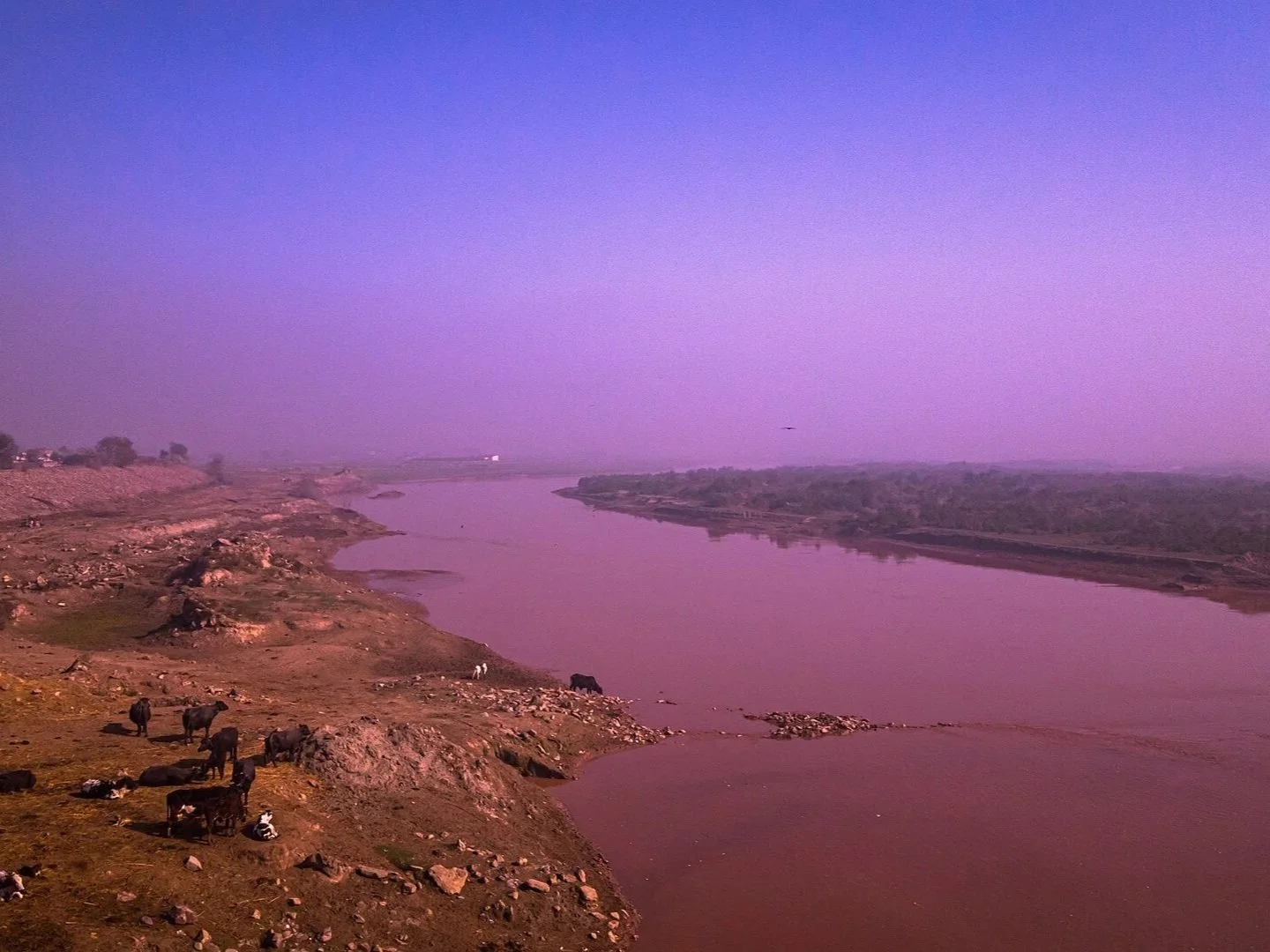
The Ravi River at dawn, Lahore. Once celebrated for its fertile floodplains, the river now sits at the centre of debates over water scarcity, pollution, and urban development.
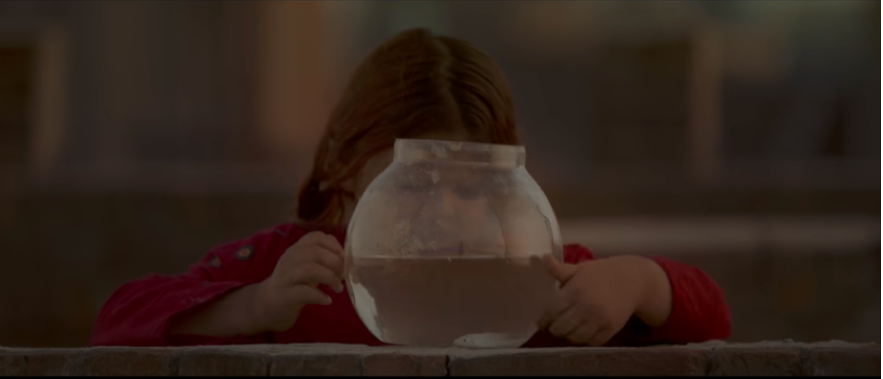
Still from The Round Lake
The most disturbing thing about The Round Lake (2022) is that it’s not a portal to a far-flung dystopian future replete with zombies or extra terrestrial forms. Technology does not yet rule mankind, and the skyline is not an excess of vast, shimmering towers. Instead, the film - which totals 11:47 minutes and is set in Lahore, Pakistan in the year 2030 - is haunting because it so closely resembles the world we live in now. It’s frightening because everything appears so freakishly normal.
Written and produced by Hira Sheraz Yousafzai and directed by Zayan Agha, the film revolves around two sisters who are seeking to replenish their state-administered rations of clean water. The older sister, Noreen played by Eman Suleman, must remain steadfast for her sister whilst battling her own exhaustion and fear. The younger sister, played by Sayeeda Pakeeza, who goes unnamed, is a pigtailed, cherubic vision of childlike innocence. We largely witness the events of the film through her perspective, as the sisters reckon with the relentless threat of environmental collapse in their quest for clean water. Implicit in the film is, of course, the threat of a future without water, but also the continuously unfolding catastrophic consequences of an exploitative colonial legacy.
Lahore is built on the banks of the Ravi River, one of the five rivers that flow through the Punjab, a key agricultural province that was divided by the British during the 1947 partition of India and Pakistan. The partition saw the construction of new borders, carving the Indian subcontinent into a new, violent geography indistinguishable from the one that preceded it. Where new borders were constructed to reassemble the land, so too were the ancient waterways forced to alter course to supply the needs of two emerging adversary nations. The 1960 Indus Waters Treaty saw India take sole control of the Ravi, Sutlej and Beas rivers, whilst Pakistan was allotted the Jhelum and the Chenab. With the construction of the Ranjit Sagar Dam and the Shahpurkandi Bridge, the Ravi’s course has been diverted to Indian administered areas. Today the historic Ravi riverbed in Lahore, which was glorified as sona (golden) for its verdant and fertile floodplains, has been rendered a clogged, polluted open sewer. This, combined with intensive irrigation methods, mass flooding and increasing droughts, has left the majority of Pakistan’s 253-million-strong population at dire risk of water scarcity.
In the film, the Ravi is invoked as an omnipresent threat as the sisters and other Lahore residents are forced to ask themselves the impossible question: when will the fear of the filthy, contaminated water of the Ravi override the fear of no water at all? But it’s a nightmare which has already been realised. The film’s opening shot is of a young child bending to collect muddy water from the Ravi riverbed into his water carrier. The white vessel fills with a smudge of thick, brown deadly liquid. From the outset, the film collapses all possibility and hope for a liveable future. The reality of a life without clean water, of death, is grimly conveyed without ceremony. In a conversation over the phone with a friend, Noreen thanks God that she hasn’t yet had to retrieve water from the Ravi, to which her friend replies ‘are you kidding? I’ve seen many neighbours collect Ravi’s sewage water.’ As if to mirror the dried, muddy banks of the Ravi, the film is colour-graded in brown sepia tones, ruptured only by the eerie white empty plastic tubs held by desperate citizens in their merciless quest for water. This is a Lahore that has been drained of all possible life.
But the reality of living in contemporary Pakistan doesn’t diverge far from the film: untreliable weather patterns have stifled agricultural growth, stalling any meaningful progress. What persists is a vicious, continuous crisis: low-yield harvests, skyrocketing food prices, and systemic unemployment across rural heartlands. Furthermore, a looming future of sustained water scarcity is poised to displace millions, deepening the cycle of instability.
In the film, after a fruitless day of searching, the younger sister stumbles upon an auction for clean drinking water. In a shadowy room filled with men dressed in dark suits whispering into their mobile phones, the auction stage is lined with towers of water jars. The light beaming down makes the water look otherworldly, ghostly and frightening. A true rarity. The auctioneer jeers at the audience to increase the bidding: ‘we are selling a very rare and precious resource! Fresh water is life! We are selling life! In this city, people are drinking the sewage water from the Ravi!’. The meaning here is clear and already playing out before our eyes: as essential natural resources become increasingly rare, only the obscenely rich will obtain ready access to them. The little sister watches with tears streaming down her face, as it’s announced that the winning bidder will be using the water to fulfill ‘his dream of buying a giant swimming pool’.
In Lahore today, the wealthy and privileged are deepening inequality on the banks of the Ravi. The Ravi Riverfront Urban Development Project (RUDA), officially launched in 2020, promises to transform Ravi’s choked floodpaines into 102,074 acres of commercial high rises and private apartment complexes. The basis for this unlawful land grab relies on the British colonial era Land Acquisition Act of 1894 which states that any land can be repossessed by the state for ‘public purposes’, with compensation to be determined on a case by case basis. RUDA’s proposal relies on snatching land from farmers, indeed 80% of the proposed territory is currently being used for agricultural purposes. Despite the warnings of the risks of dangerous flooding, especially during the heavy rains of the monsoon season, RUDA’s progress is set to continue.The colonial legal frameworks and exploitative civil infrastructure left by the British continue to shape Pakistan’s water governance, but they have also been actively maintained and expanded by the country’s contemporary elites. ; a stark reminder that capitalist interests will always prevail over ecological harmony and human life.It is important to recognise that Pakistan remains a "semi-feudal" society, where vast stretches of the rural heartland are governed by a handful of powerful urban elite families. This structural imbalance is most visible in the nation's fiscal landscape: while the agricultural sector generates a full one-fifth of the GDP, it contributes less than 0.1 per cent to total tax revenues. This stark disparity is not merely a statistical anomaly, but a modern extension of a long-standing legacy defined by dominance and exploitation. All of these ongoing political tensions loom implicitly over the proceedings of the film, as we collectively hurtle towards a future of devastation.
The film’s unsentimental, clear-eyed sense of loss endures till the very end. The younger sister’s beloved fish, housed in a small fishbowl, is her constant companion that she sings to whilst her older sister descends into panic. The last shot of the film sees the child considering the fish, before walking away from an empty bowl. We can only assume she has drunk the water. It’s a small loss, but a profound one - and leaves us contending with the numerous other sacrifices that will have to be made to sustain a future without water.
Image: Shahzaib Damn Cruze / Wikimedia Commons (CC BY-SA 4.0). Cropped from the original.